
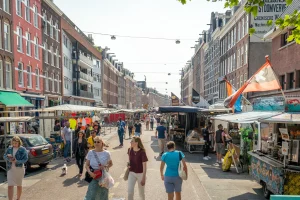
Three days is enough to experience the essential sides of Amsterdam without turning the trip into a race.
This itinerary groups attractions by area so you spend more time exploring and less time travelling back and forth across the city. It combines the historic canal centre, Jordaan, a major museum, De Pijp and Amsterdam Noord, while leaving space for food, walking and an Amsterdam canal experience.
Amsterdam 3-day itinerary at a glance
Day 1: Historic centre → Canal Ring → Jordaan → Anne Frank House or canal cruise
Day 2: Rijksmuseum → Museumplein → Vondelpark → De Pijp → Albert Cuyp Market
Day 3: Amsterdam Noord → NDSM → flexible final afternoon in the centre
Before you start
- Ideal trip length: 3 full days, or 3 nights/4 days if arrival and departure days are partial
- Best transport: Walking combined with trams and metro
- Book ahead: Anne Frank House, Rijksmuseum and other high-demand museums
- Do not overbook: One major museum per half-day is usually enough
- Best approach: Explore Amsterdam in geographical clusters rather than crossing the city repeatedly
The Anne Frank House is particularly important to reserve in advance: tickets are sold only online for a specific time slot, with new tickets currently released every Tuesday at 10:00 CEST for visits six weeks later.
Day 1 – Historic Amsterdam, canals and Jordaan
Morning: Amsterdam Centraal and the historic centre
If this is your first visit, start around Amsterdam Centraal Station.
Rather than immediately jumping on public transport, walk into the historic centre. Amsterdam’s compact layout means many of the central landmarks work better as part of one continuous walk.
A simple route can include:
- Amsterdam Centraal
- Damrak
- Dam Square
- the surrounding historic streets
- Begijnhof
- Spui
- the Canal Ring
Do not try to stop at every attraction. The point of the first morning is to understand the city layout and get your first experience of Amsterdam’s canal architecture.
Allow
Approximately 2–3 hours, depending on stops.
Lunch: historic centre or Jordaan
Instead of staying around the busiest streets immediately beside Dam Square, continue towards the Jordaan for lunch.
This is also a good opportunity to start trying Amsterdam food rather than treating meals simply as gaps between attractions.
You could choose a café, bakery or casual Dutch lunch and save a more substantial restaurant meal for the evening.
Afternoon: Jordaan and the western Canal Ring
Spend the afternoon exploring the Jordaan, one of Amsterdam’s best-known historic neighbourhoods.
The area works particularly well on foot, with canals, smaller streets, galleries, cafés and historic buildings. Amsterdam’s official visitor service describes Jordaan as one of the city’s best-known neighbourhoods and highlights its galleries, museums and local café culture.
A relaxed walking route can take you around:
- Prinsengracht
- Westerkerk area
- Jordaan side streets
- Brouwersgracht
- smaller canals connecting back towards the centre
This part of the itinerary should remain relatively unstructured. Amsterdam is one of those cities where the streets between attractions are part of the attraction.
Late afternoon: Anne Frank House – if you have tickets
If the Anne Frank House is important to you, Day 1 is a logical place for it because it sits beside the Jordaan at Westermarkt 20.
Do not simply arrive and expect to buy admission. The museum currently requires online timed tickets, and tickets are not sold at the entrance. A museum visit itself takes approximately an hour.
If you cannot get tickets, do not redesign the entire trip around it. Continue exploring Jordaan and the Canal Ring instead.
Evening: canal cruise
A canal cruise makes sense on the first evening because you now recognise some of the streets and neighbourhoods you are seeing from the water.
Amsterdam’s 17th-century Canal Ring is UNESCO-listed, and standard sightseeing cruises generally take about an hour while passing many of the central landmarks.
A sunset or early-evening cruise can work particularly well, depending on season.
Day 1 pace
Moderate
You are seeing a lot, but most of the day is geographically concentrated.
Day 2 – Rijksmuseum, Vondelpark and De Pijp
Day 2 focuses on Amsterdam’s museum district and southern neighbourhoods.
Morning: Rijksmuseum
Start with one major museum.
For a first visit, the Rijksmuseum is the strongest general introduction to Dutch art and history.
It is open daily from 09:00 to 17:00, and visitors currently need to reserve a start time. The museum recommends booking online in advance to secure the preferred slot.
Allow around 2–3 hours if art and history interest you.
You do not have to see every gallery. Trying to “complete” a major museum often makes the rest of the day unnecessarily tiring.
Alternative
If Van Gogh is a much bigger priority for you, substitute the Van Gogh Museum rather than attempting both major museums in the same morning.
Late morning: Museumplein
After leaving the museum, spend a little time around Museumplein rather than immediately boarding a tram.
This gives the day some breathing room and keeps you within the same neighbourhood.
Lunch and early afternoon: Vondelpark
Walk towards Vondelpark.
The park gives you a useful change from museums, canals and dense historic streets.
You do not need to cross the entire park. A relaxed walk and lunch or coffee stop are enough before continuing towards De Pijp.
This kind of unstructured time is important in a three-day itinerary. Filling every hour with ticketed attractions makes Amsterdam feel much more exhausting than it needs to be.
Afternoon: De Pijp and Albert Cuyp Market
Continue towards De Pijp, one of the city’s liveliest neighbourhoods.
The main anchor here is Albert Cuyp Market.
The market has around 260 stalls and currently operates Monday to Saturday, 09:00–18:00. It sells produce and everyday goods as well as Dutch foods such as herring and freshly prepared stroopwafels.
This makes it a very good stop for combining sightseeing with food.
Try one or two things rather than treating the market as another checklist.
Depending on what appeals to you, look for:
- fresh stroopwafel
- herring
- kibbeling
- Dutch cheese
- fries
- other market snacks
Important
If Day 2 falls on a Sunday, Albert Cuyp Market is not part of the normal Monday–Saturday market schedule, so rearrange this section or concentrate on De Pijp’s cafés and restaurants instead.
Evening: dinner in De Pijp
Stay in the neighbourhood for dinner rather than travelling back into the most tourist-heavy part of the historic centre.
De Pijp’s mixture of Dutch and international food also makes it a useful place to connect this itinerary with your separate Amsterdam Food Guide.
Day 2 pace
Moderate to active
The museum requires concentration, but the park and market balance the day.
Day 3 – Amsterdam Noord and a different side of the city
The third day should not simply repeat canals and museums.
Cross the IJ to experience a different Amsterdam.
Morning: free ferry from Amsterdam Centraal
Go to the waterfront behind Amsterdam Centraal and take one of the city’s ferries to Amsterdam Noord.
The ferries are free for pedestrians and cyclists, with connections from behind Central Station to areas including Buiksloterweg and NDSM.
Even the journey itself provides a useful change of perspective.
Option A: Buiksloterweg
Choose this route if you want an easier and shorter Noord visit.
It gives access to the waterfront around:
- EYE Filmmuseum
- A’DAM area
- Tolhuistuin
- surrounding parts of Noord
The crossing is particularly convenient and ferries operate frequently during the day.
This option works well for families or travellers who do not want another long walking day.
Option B: NDSM Wharf
For something more contrasting, take the ferry towards NDSM.
This former shipyard has developed into a creative district with large-scale street art, studios, cultural spaces and waterfront venues.
Amsterdam’s official tourism service specifically recommends NDSM for its former industrial setting, artists’ studios and creative spaces.
Spend roughly 2–3 hours here rather than treating Noord as an entire separate day trip.
Afternoon: return to central Amsterdam
After returning across the IJ, keep the final afternoon flexible.
This is deliberate.
Three-day itineraries often fail because the final day becomes a dumping ground for everything that did not fit earlier.
Instead, choose one option based on what you enjoyed most.
Option 1 – More canals and neighbourhood time
Return to the Canal Ring and explore streets you missed on Day 1.
Best for travellers who discovered that wandering Amsterdam was more enjoyable than ticking off attractions.
Option 2 – Another museum
Choose this if museums are a major reason for your visit.
This is where a second museum can fit far more comfortably than squeezing two major institutions into Day 2.
Option 3 – Shopping
Use the final hours for Dutch design, independent shops, souvenirs or speciality food.
Option 4 – Food-focused afternoon
Return to Jordaan, De Pijp or another neighbourhood for a slower food experience.
Option 5 – Vondelpark or café time
If your first two days were already busy, doing less may actually produce the better final day.
Should you take a day trip during a 3-day Amsterdam visit?
For most first-time visitors, I would not automatically use one of only three days for a full day trip.
Amsterdam itself easily fills three days.
If you have four or five days, then destinations outside Amsterdam become much easier to justify.
That said, travellers with one very specific priority—such as seasonal flowers, traditional villages or another Dutch city—can substitute Day 3.
The important thing is to replace a day, not add a day trip on top of an already full Amsterdam schedule.
How much walking is involved?
Quite a lot.
Amsterdam is compact, but a three-day trip can still involve several hours of walking every day.
Comfortable shoes matter more than they may appear when looking at a map because sightseeing involves canal bridges, historic streets, museums and standing as well as straightforward distance.
Use trams or metro when they eliminate unnecessary backtracking, but don’t automatically take public transport between nearby central sights.
What should you book before arriving?
For this itinerary, prioritise reservations in approximately this order:
1. Anne Frank House
This requires the most advance planning because admission is exclusively through online timed tickets. Tickets are currently released six weeks ahead every Tuesday at 10:00 CEST.
2. Major museum
The Rijksmuseum requires a starting time and recommends advance online booking.
3. Canal cruise
You have more flexibility here, but booking ahead can still be useful during busy travel periods or when you specifically want an evening departure.
Do not pre-book every hour of the trip.
Amsterdam benefits from having room for weather changes, cafés and spontaneous neighbourhood exploration.
Amsterdam 3-day itinerary summary
| Day | Morning | Afternoon | Evening |
|---|---|---|---|
| Day 1 | Historic centre | Jordaan + Anne Frank House if booked | Canal cruise |
| Day 2 | Rijksmuseum | Vondelpark + De Pijp + Albert Cuyp | Dinner in De Pijp |
| Day 3 | Amsterdam Noord/NDSM | Flexible final Amsterdam experience | Relaxed final evening |
If you arrive late on Day 1
Do not try to compress the entire first-day itinerary into a few hours.
Instead:
Arrival day: Canal walk + dinner
Day 1: Historic centre + Jordaan + Anne Frank House
Day 2: Rijksmuseum + Vondelpark + De Pijp
Day 3: Noord + remaining sights
This is why three full days or four calendar days works better than calling a Friday-night-to-Monday-morning trip “three days.”
Practical FAQ
Are 3 days enough for Amsterdam?
Yes. Three full days are enough for the historic centre, canals, one or two major museums, Jordaan, De Pijp and another neighbourhood such as Amsterdam Noord without making the trip excessively rushed.
Should I visit the Anne Frank House?
It is one of Amsterdam’s most historically significant visitor experiences, but whether you include it depends on your interests and ticket availability. If you plan to visit, obtain the official timed ticket well in advance.
Do I need a canal cruise?
No attraction is compulsory, but a canal cruise makes particular sense in Amsterdam because the historic Canal Ring is fundamental to understanding the city’s layout and architecture.
Should I rent a bicycle?
Not necessarily.
Amsterdam’s cycling culture is part of the city, but a first-time visitor does not need to cycle to have a good trip. Walking and public transport are perfectly practical. If you are not comfortable cycling in busy urban conditions, there is no reason to make it compulsory.
Is the itinerary suitable for families?
Broadly yes, but families with younger children may want shorter museum visits, more park time and the easier Buiksloterweg option on Day 3 rather than a long NDSM exploration.
Related TripAdept guides
- Amsterdam Destination Guide
- Best Time to Visit Amsterdam
- What to Wear in Amsterdam
- Amsterdam Food Guide
- Amsterdam on a Budget
- Amsterdam History Guide
TripAdept planning note: Attraction availability, ticket procedures, opening hours, ferry services and market schedules can change. Check official sources before finalising the itinerary.